The main points
- The Original Fjord Cruise to Mostraumen runs 3.5 hours from US$93 and is rated 4.69 from 9,652 reviews.[1]
- The boat noses in to a waterfall close enough that crew sometimes scoop mountain water in a cup for passengers.[2]
- Mostraumen is a narrow, shallow tidal channel roughly 600 m long and about 50-60 m wide at its narrowest.[2]
- Bergen receives 2,490 mm of precipitation per year, spread over 198 days.[3]
- The shortest day in Bergen is 7.7 hours long on the winter solstice, December 21st, and the longest is 23.1 hours on June 21st.[4]
- Top choice Original Mostraumen cruise from US$93 Duration3.5 hours[1]Rated4.69 from 9,652 reviews[1]GuideAudio guide in English and Norwegian[1]RouteBryggen, Osterfjord, Mostraumen Check availability
- Mostraumen with a local crew from US$88 Duration3.5 hours[5]Rated4.57 from 4,302 reviews[5]GuideDriver: English[5]RouteBryggen, Nordhordland Bridge, Osterfjord, Mostraumen See this tour
- Mostraumen with live guide from US$80 Duration3.5 hours[6]Rated4.74 from 2,368 reviews[6]GuideLive tour guide: English[6]RouteBryggen, Sandviken, Osterfjord, Mostraumen, Modalen See this tour
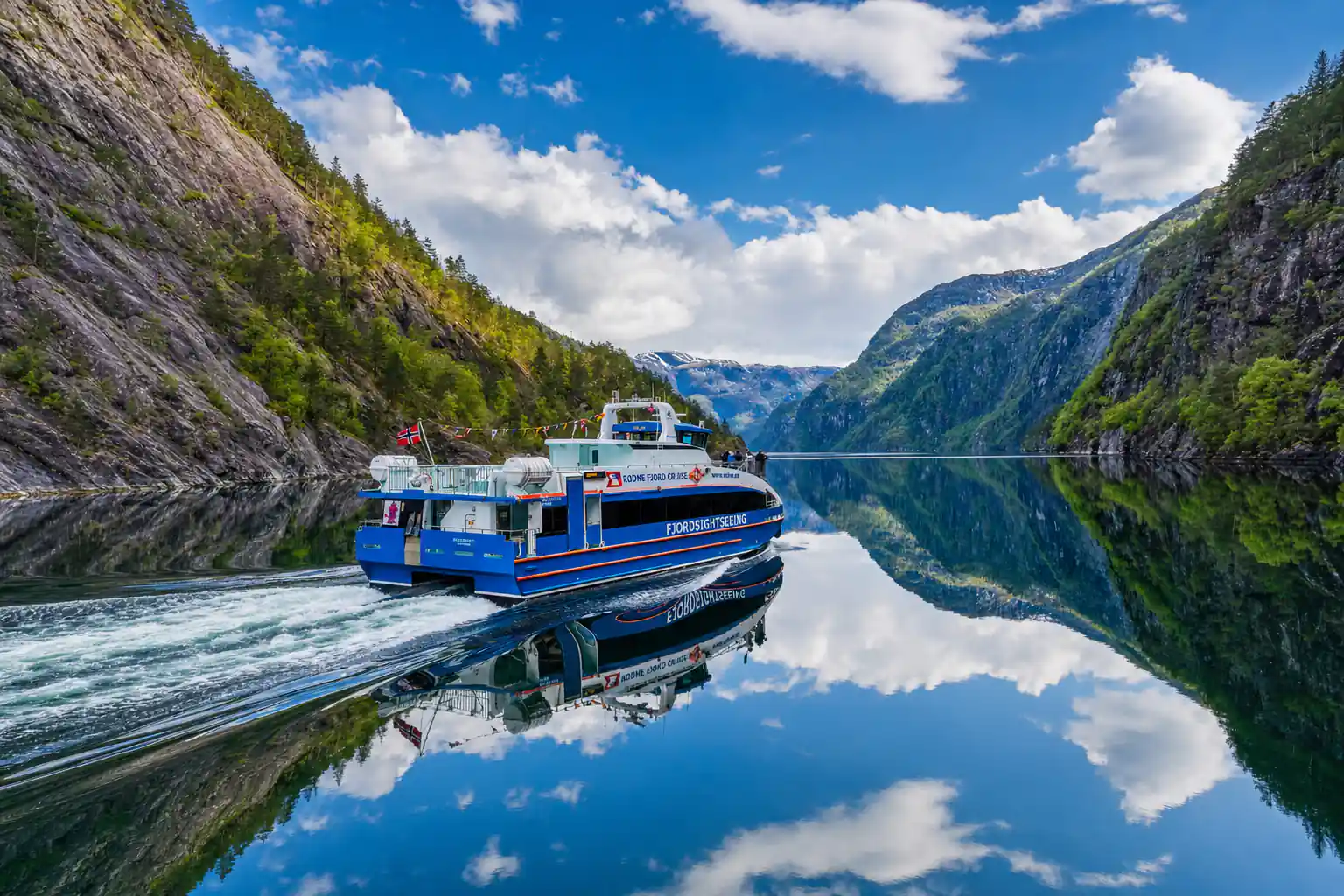
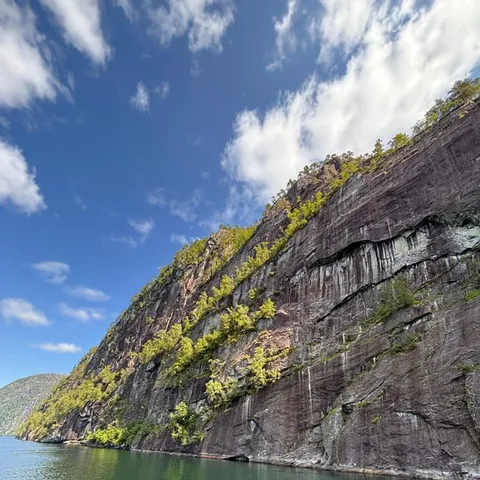
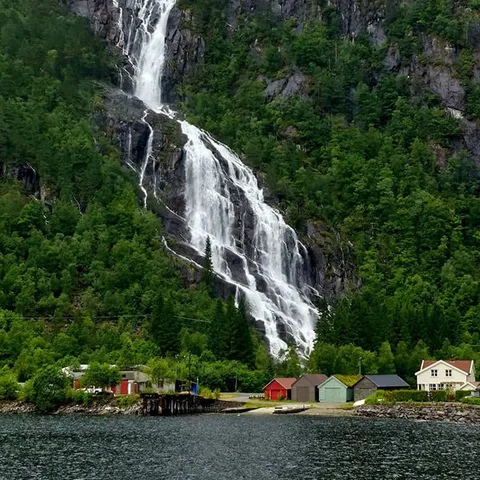
Strong tidal currents run through the strait, and the boat noses up to a waterfall close enough that crew sometimes scoop mountain water in a cup for passengers.
Is the waterfall stop worth it?
Before you board
What happens as the boat leaves Bergen
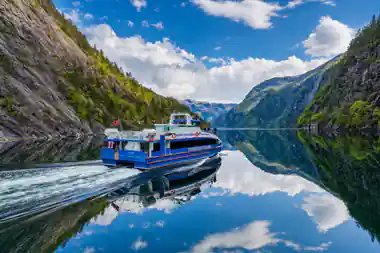
The Original Fjord Cruise to Mostraumen leaves from Bryggen, the old timber wharf on Bergen's waterfront, which was inscribed on the World Heritage List in 1979.[8] The listed stops are Bryggen, then Osterfjord, then Mostraumen, and the duration is 3.5 hours.[1] It is a compact trip by fjord standards. You board in the middle of the city, and within a few minutes the cranes and church spires of the harbour are behind you and the water opens out.
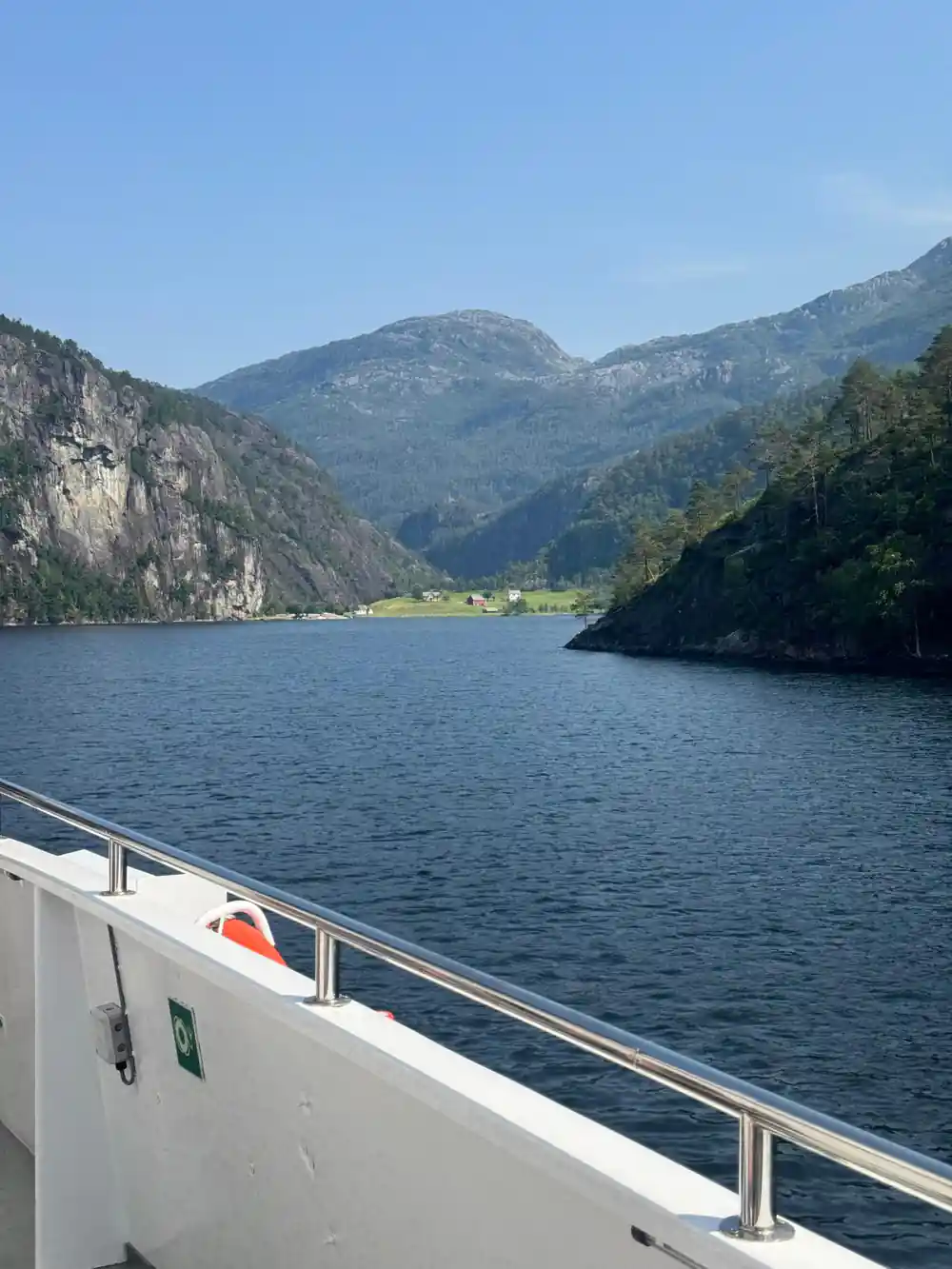
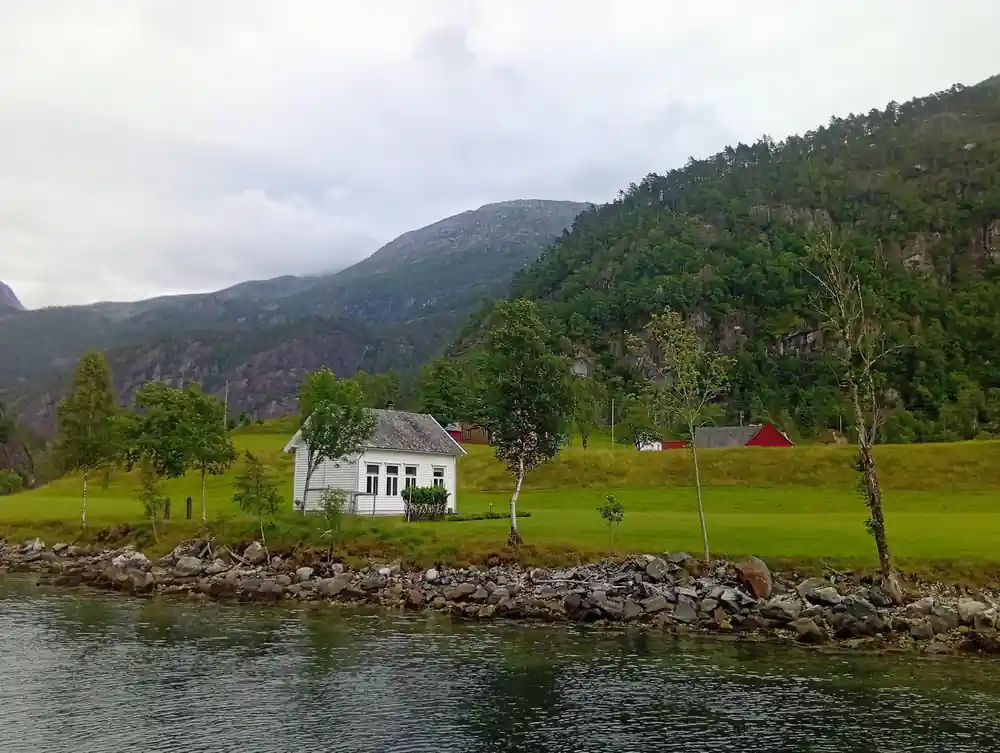
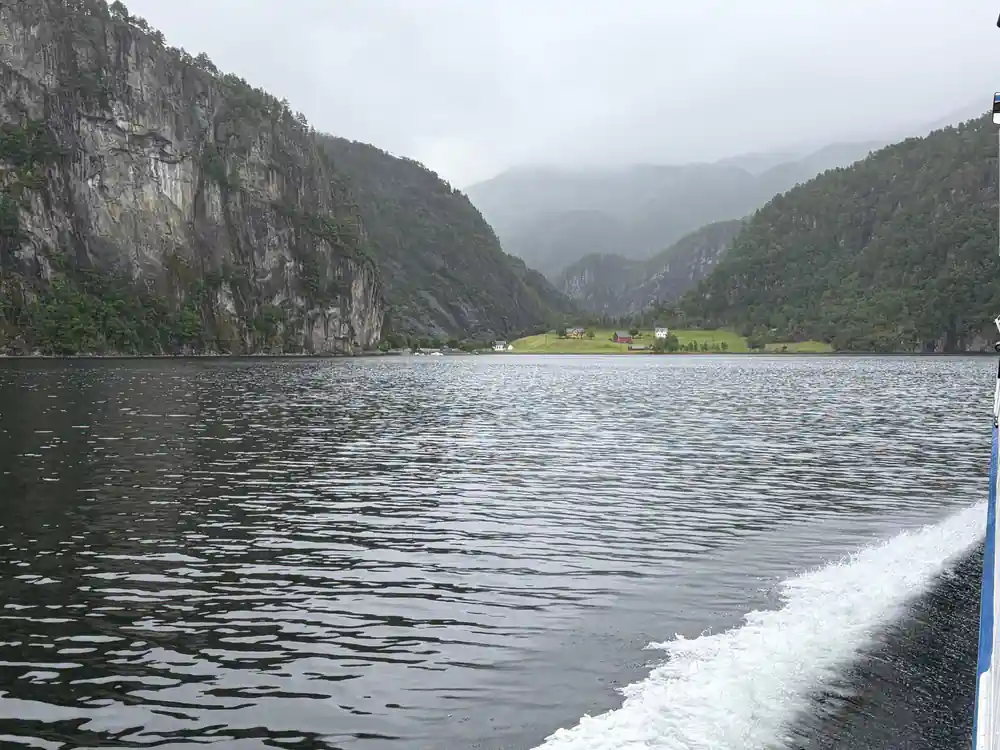
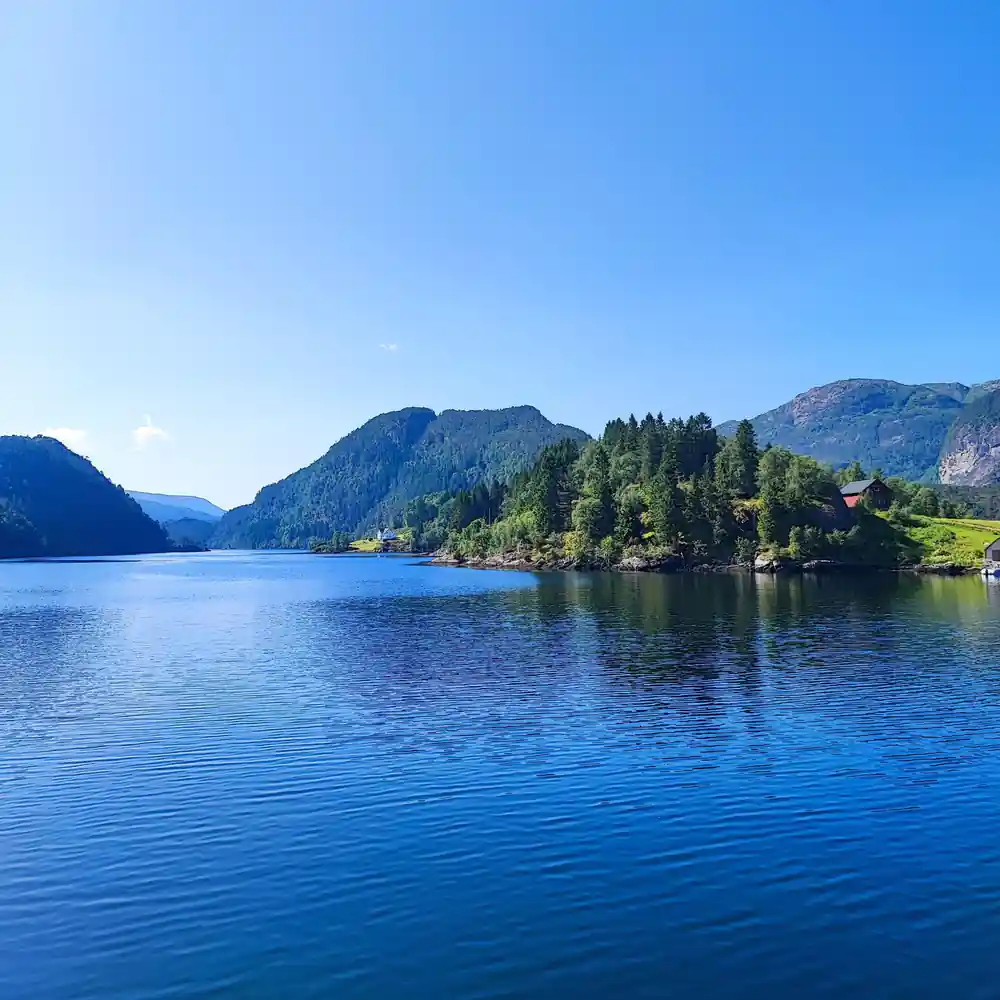
Osterfjord comes first, wide and grey-green, with low wooded islands, boathouses standing on stones, and small farms scattered up the slopes. The water is calm in the middle of the fjord and darker close in to shore, and gulls follow in the wake. On a clear day the far hills sit in layers, each one paler than the last. On a wet day they simply disappear into cloud, and that is part of the scenery too.
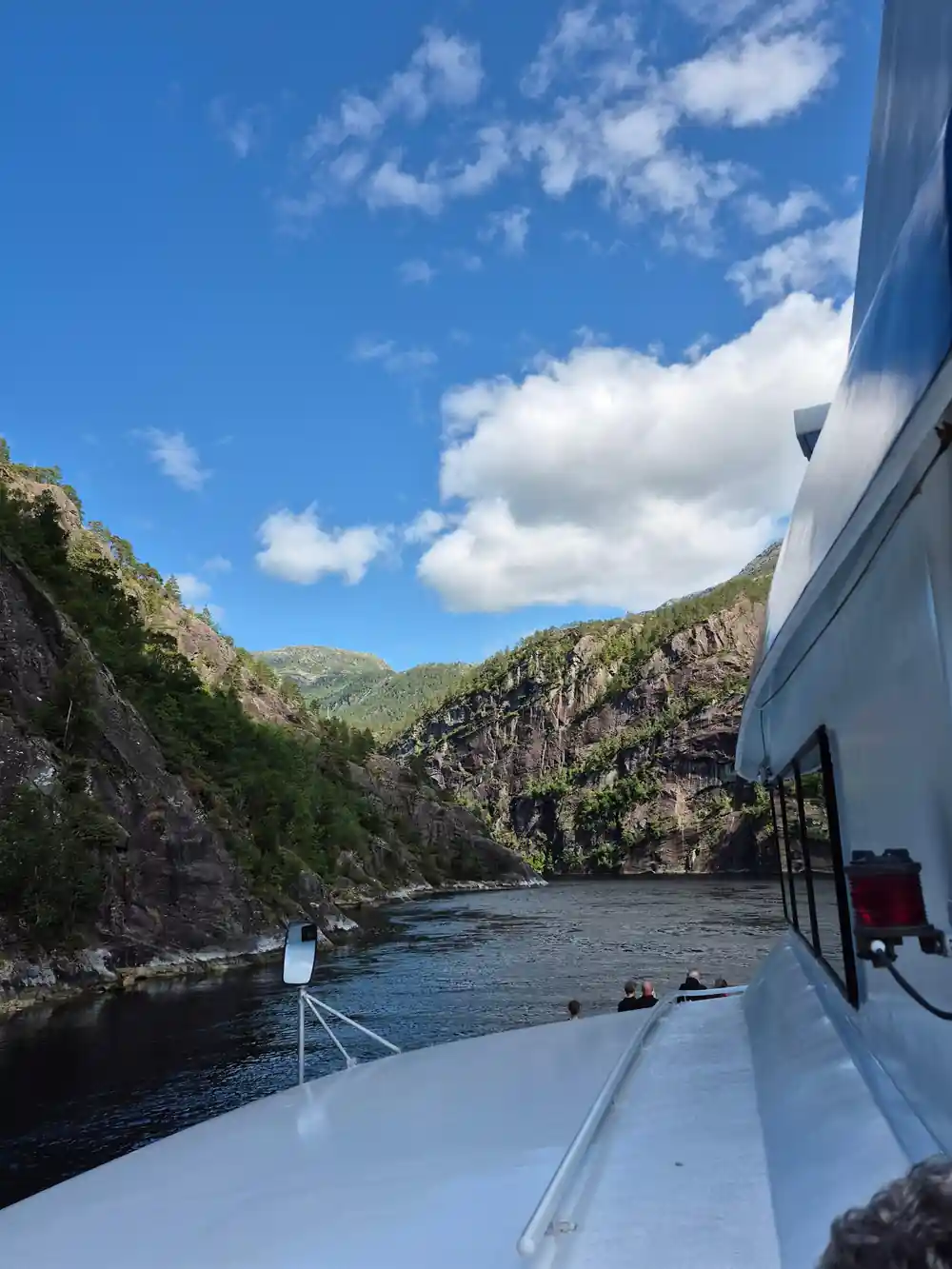
Then the land closes in. The fjord narrows toward the Mostraumen strait, the cliffs come nearer on both sides, and the note of the engine drops as the boat eases back. You usually hear the waterfall before you see it: a steady rush underneath the machinery. Passengers move to the rail, phones come out, and the crew point ahead and to the side.
How close does the boat get?
Mostraumen is a narrow, shallow tidal channel roughly 600 m long and about 50-60 m wide at its narrowest, and strong tidal currents run through it.[2] At that width a boat fills the gap between the rock walls. You can pick out individual stones and strands of weed sliding past under the surface, and the cliffs on either side rise steeply enough that you have to tilt your head back to see the top.
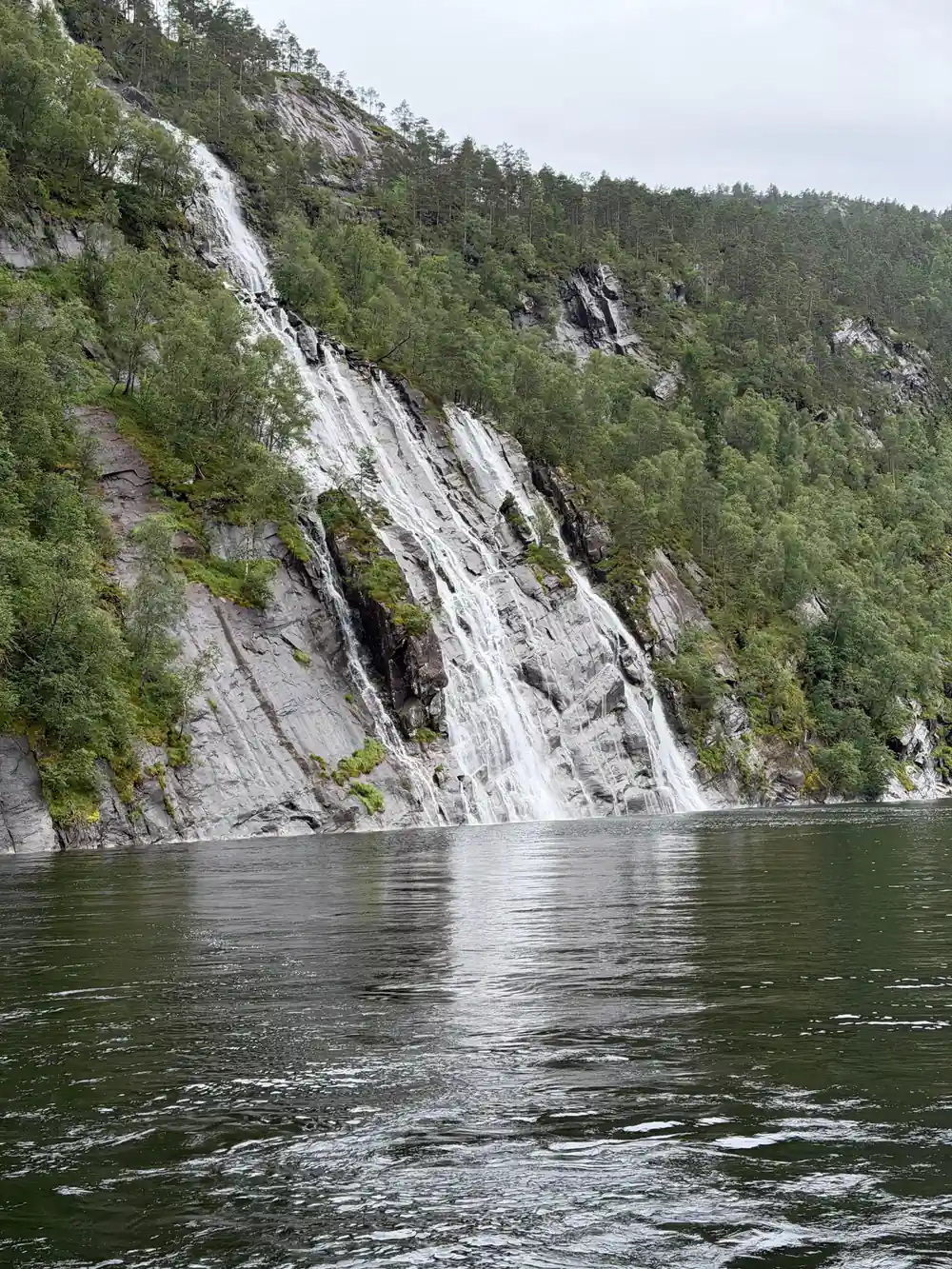
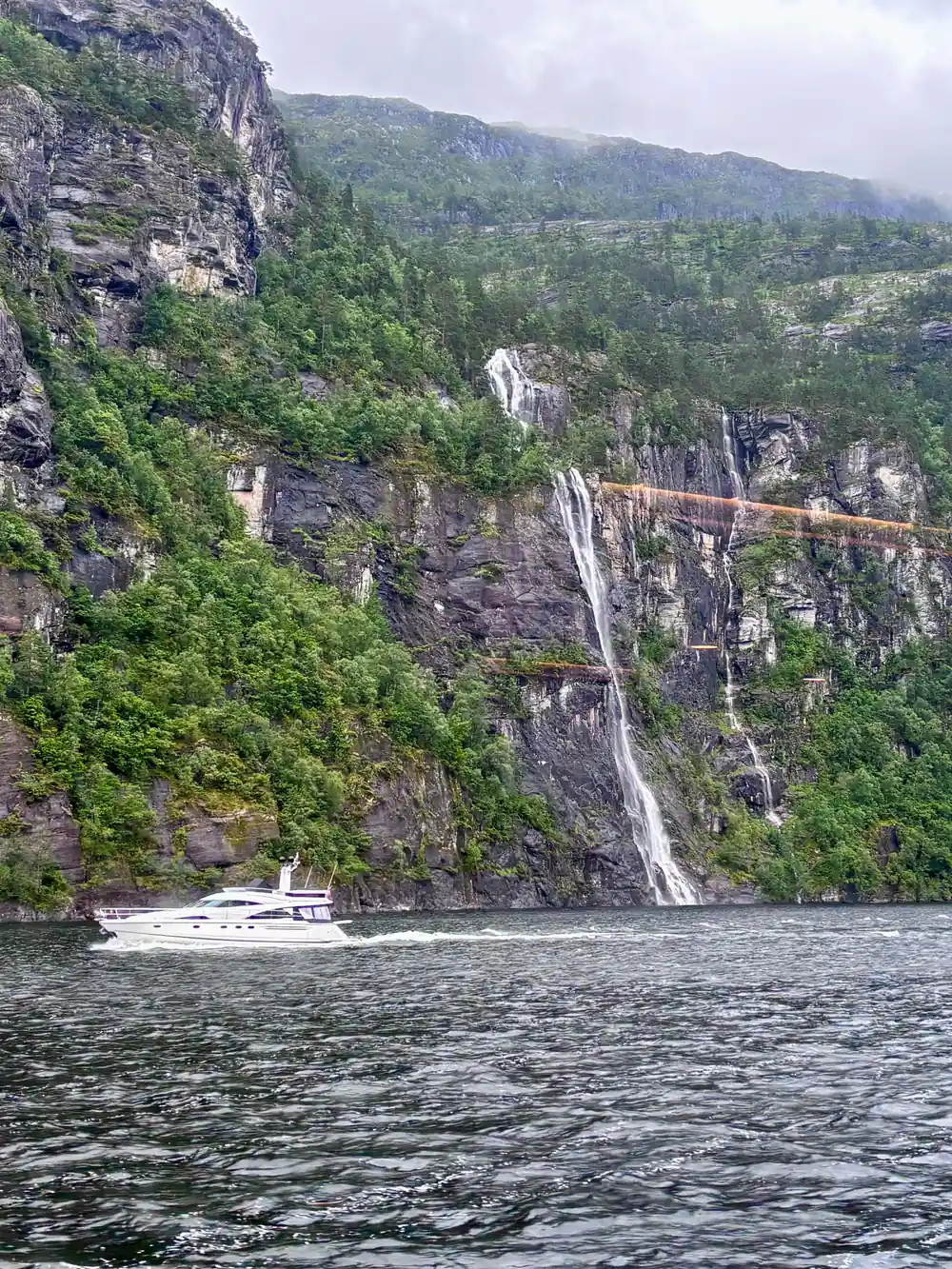
The boat noses in to a waterfall close enough that crew sometimes scoop mountain water in a cup for passengers.[2] In plain terms you stop so near the rock that spray reaches the forward deck and the falling water is the loudest sound around. The pause itself is quiet and unhurried. The engines idle, the boat holds its position, and everybody looks up at the same time.
Two things shape the approach. In Norway, a 5-knot speed limit is commonly set within 150 meters of shore, including in narrow straits and harbour approaches.[9] The water level moves as well: in Bergen the mean tidal range is about 91 cm and the spring tidal range about 123 cm.[10] Neither is dramatic on its own, and what you notice from the deck is simply the careful, unhurried way the boat works its way in.
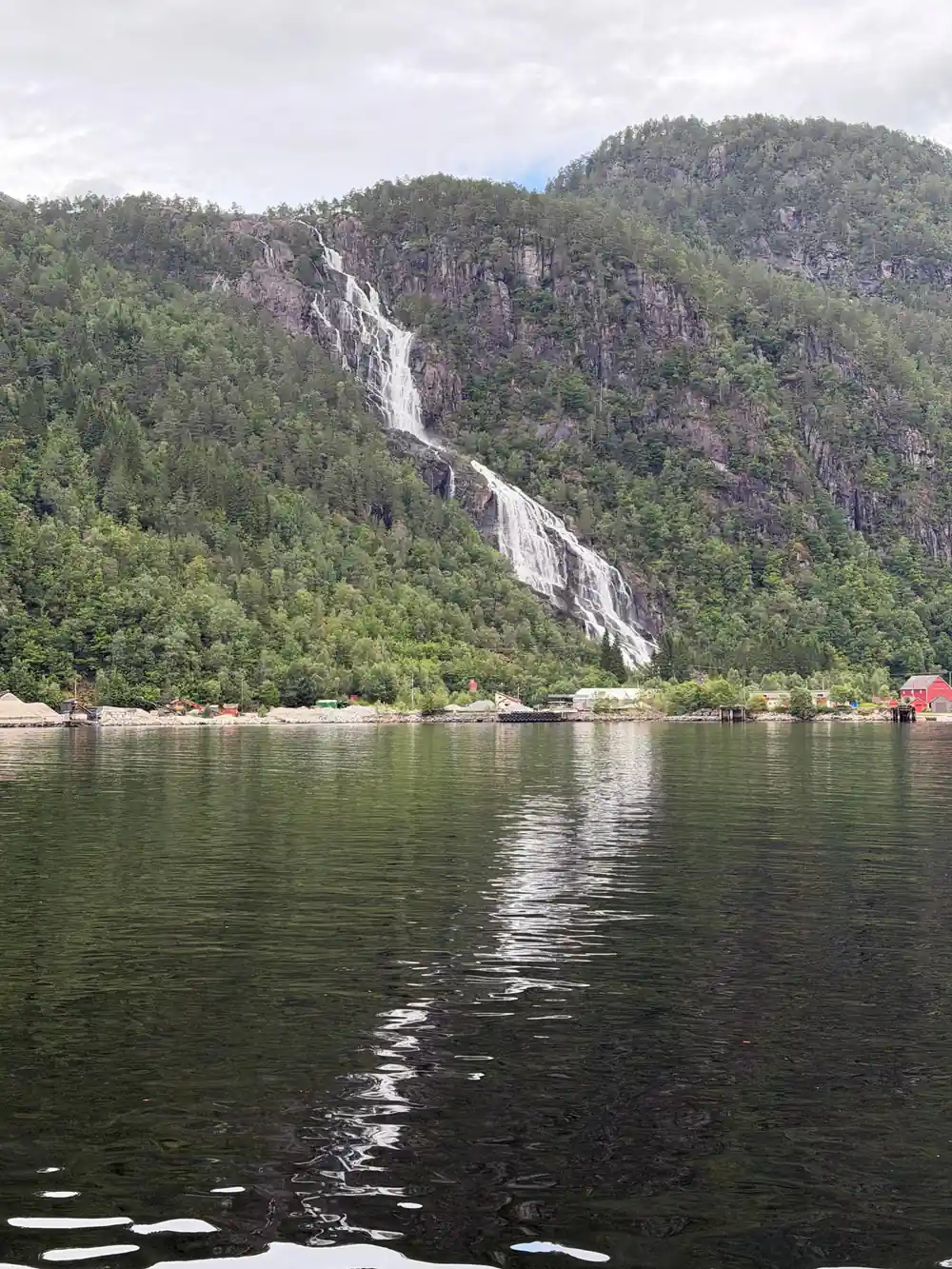
The falls drop down a wooded cliff straight into the fjord.
Why a wet day gives a better waterfall
Bergen receives 2,490 mm of precipitation per year, spread over 198 days.[3] That single line explains a lot about the west coast. For a waterfall trip it is good news: the falls are fed by rain and snowmelt, and the days after a wet spell usually bring more water over the edge, a wider white curtain against dark rock, and more spray in the air.
Drizzle often suits the scene better than a downpour. Mist hangs in the trees, the far shore fades to grey, and the waterfall reveals itself gradually as you round the last bend rather than presenting itself flatly from a distance. Photographs taken in soft grey light are often easier to work with than ones taken in hard sun, when white water and bright sky compete.
Staying comfortable is mostly a matter of kit. A waterproof shell over a warm mid layer, a hat that stays on in wind, and shoes with some grip will see you through a long spell on an open deck. A dry bag for the camera and phone costs very little and saves the day, and gloves are worth packing even in summer, because a boat moving through a fjord feels cooler than the town does.
Other waterfalls along the way
The fall in the strait is the one everybody waits for, but it is rarely the only water you pass. After rain, thin white threads run down the cliffs on both sides of Osterfjord. Some tumble a long way down bare rock, others are small enough to miss entirely if you are looking at your phone.
Keep an eye on the rock faces and the sky above them. Norway is home to the largest breeding population of white-tailed sea eagles in Europe, with 2,500 breeding pairs.[11] They are heavy, slow-winged birds, and when one crosses the fjord you tend to notice the movement before you work out what it is.
Below the boat, harbour porpoise abundance in Norwegian waters is estimated at about 82,600 for the southern component and about 11,000 for the northern component.[12] Sightings are brief and easy to mistake for a wave breaking in open water. The practical approach is simply to keep looking at the surface in the calm stretches between cliffs and waterfalls, and to keep your camera in a pocket rather than in a bag.
from US$93
The Original Fjord Cruise to Mostraumen leaves from Bryggen, runs 3.5 hours and includes an audio guide in English and Norwegian.[1]
Getting a good photograph of the falls
The waterfall is photographed from a moving deck, which changes everything. Choose your place early, before the boat slows, and stand where nobody can step in front of you. The bow gives you the head-on view. The sides give you the cliff, the boat and the water together, which is usually the more interesting picture.
Spray is the enemy. A microfibre cloth in a pocket, a dry bag or a plastic sleeve for the phone, and a lens hood if you have one will keep the glass clear long enough to work with. Wipe between shots rather than during them, and accept that a few frames will come back soft or smeared.
The settings are simple enough. A fast shutter freezes the falling water in mid-air; a slower one turns it into a white ribbon, which needs something solid to lean against. Keep the horizon level, expose for the white water rather than the dark rock, and shoot wide before you shoot tight. The best moment is usually the slow approach rather than the stop itself, because the falls grow as the boat closes in.
The waterfall in winter
On the winter solstice, December 21st, the shortest day in Bergen is 7.7 hours long.[4] Daylight arrives late and leaves early, and for much of it the light sits low and silvery on the water. That is beautiful light for a fjord, but there is not much of it, so plan the rest of your day around the hours you have.
The Bergen climate table for 1981-2010 gives daily mean air temperatures from 1.4°C to 14.5°C, with an annual mean of 7.3°C.[7] Those are averages rather than extremes, and a day on open water feels colder than the same temperature in town. Layers, gloves and a windproof outer layer do more for you than one heavy coat.
Winter changes the look of the water too. Snow on the cliffs makes every fall stand out sharply, and the strait feels narrower and quieter without summer traffic. The harbour itself still fills up: in 2024 Bergen had 631,000 cruise passengers, according to the port's statistics.[13] Booking ahead is wise in the busy months, and the season matters less than the weather on the day.
If you would rather stay dry
You do not have to stand in the weather. The boat has indoor seating, and the audio guide comes in English and Norwegian.[1] On a cold or wet day the saloon fills quickly. Claim a seat early if you want one, then treat the deck as somewhere you visit rather than somewhere you live.
Watching a fjord through glass is still watching a fjord. The shoreline slides past, the water changes colour as the depth changes under the hull, and you can hear the commentary without shouting over the wind. It is perfectly possible to do the whole crossing inside and step out only when the engines drop.
Do step out for the falls, though. The boat holds its position close to the rock, and that short pause is the reason for the trip. A jacket over indoor clothes is enough if you are only out for a moment. Then back inside, hands around something hot, while the cliffs slide away behind you and the fjord opens out toward Bergen again.
Bergen rainfall in the wettest months
Monthly rainfall for Bergen from the same climate table; the year totals 2,490 mm.[3]
What a Mostraumen cruise costs from
From-prices for the four Mostraumen listings cited below; no child prices are listed.[1][5][6][14]
When to book a Mostraumen cruise
Getting close to the falls
Book the cruise
The Original Fjord Cruise to Mostraumen starts at Bryggen, runs 3.5 hours and is listed from US$93.[1]
Dress for spray
A waterproof shell, a warm layer and shoes with grip keep a morning on deck comfortable.
Take the rail early
Positions along the rail fill as the strait narrows, and the slow approach is the best part of the view.
Listen for the engines
The boat noses in to the waterfall close enough that crew sometimes scoop mountain water in a cup for passengers.[2]
Stay out for the return
The cliffs keep going after the falls, and the light on the water changes all the way back to Bergen.
See the waterfall from the water on the Original Mostraumen cruise
from US$94Reserve now & pay later